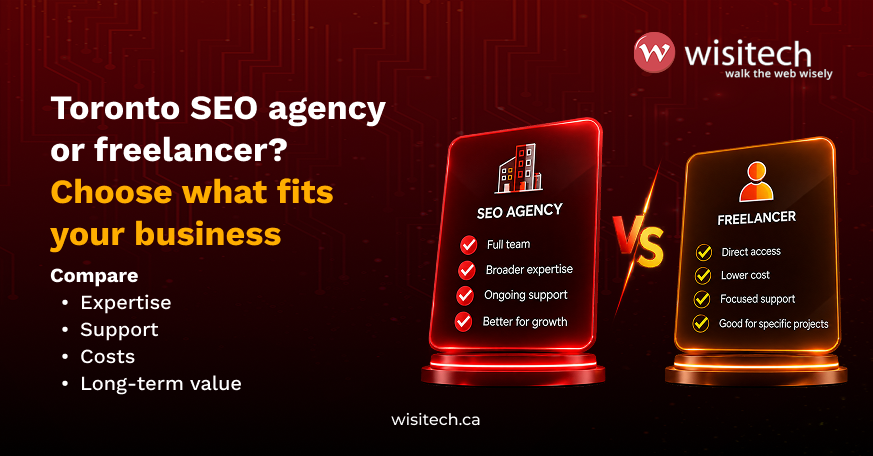
Choosing between a Toronto SEO agency and an independent freelancer is rarely just a question of price. The more useful comparison is about scope, execution, specialization, accountability, and what your business needs from SEO over time.
A freelancer can offer direct access to one specialist. An agency can bring several capabilities into the same engagement. Neither model fits every business in the same way.
For a Toronto business, the decision becomes clearer when you look at what needs to happen after the strategy is created. Who handles technical SEO? Who manages local search? Who builds content? Who monitors performance? Who adapts the strategy when Google changes how results are presented? And who can help when your business starts appearing in AI-generated answers as well as traditional search?
The decision starts with the work, not the label
The decision is rarely about choosing between an agency and a freelancer in the abstract. A Toronto SEO agency should be evaluated against the specific work your business needs.
A freelancer and a Toronto SEO agency can both work on keyword research, on-page optimization, technical audits, content strategy, local search, and performance reporting.
The difference is often the structure behind the work.
A freelancer usually gives you a direct relationship with one professional. That can be useful when the project has a narrow scope, your internal team can handle implementation, or you need strategic guidance from an experienced specialist.
An agency can bring multiple disciplines into one workflow. Depending on the provider, that may include SEO specialists, content strategists, technical SEO professionals, analytics support, developers, and account management.
The important question is not whether one model is automatically better. It is whether the model gives your business enough capacity to execute the work properly.
What a freelancer can offer
A freelancer can be a practical option when you know exactly what you need.
For example, a business with an established website, internal content resources, and a developer may only need an SEO specialist to:
- Audit the website
- Research keywords
- Build an SEO strategy
- Review existing content
- Create content briefs
- Identify technical issues
- Advise on local SEO
- Review monthly performance
That structure can keep communication simple because the business works directly with the person doing the SEO work. A business comparing a freelancer with a Toronto SEO agency should also consider who will implement the recommendations.
It can also work well for consulting engagements or defined projects.
The limitation to examine is capacity. If your strategy requires technical fixes, continuous content production, local SEO management, structured data, analytics, and regular optimization, one person’s availability can become an important consideration.
What an agency brings to the table
A Toronto SEO agency can provide a broader operating structure when SEO involves several types of work.
A modern SEO program may include:
- Technical SEO
- On-page SEO
- Local SEO
- Content strategy
- Google Business Profile optimization
- Citation building
- Schema markup
- Ecommerce SEO
- Conversion-focused content
- AI search optimization
- Performance tracking
- Ongoing optimization
These areas overlap, but they are not identical.
For example, a local SEO strategy may involve Google Business Profile optimization, citation consistency, location pages, map visibility, and local schema.
A technical SEO strategy may involve site speed, crawlability, indexing, Core Web Vitals, schema, and technical implementation.
An AI search strategy may involve content structure, conversational queries, AI Overviews, answer engines, and how information is presented to systems such as ChatGPT and other AI platforms.
When all of these areas matter, the number of capabilities available to you becomes part of the comparison. A Toronto SEO agency may be useful when those capabilities need to work together continuously.
Local SEO requires more than adding a city name
For Toronto businesses that depend on customers in a specific location, local search can be a major part of the SEO strategy.
Local SEO is not simply about putting “Toronto” into page titles.
A structured local SEO program can include:
- Google Business Profile optimization
- Local citation building
- Consistent business information across directories
- Map pack monitoring
- Location pages
- LocalBusiness schema
- Service schema
- Review processes
- Local content
- On-page optimization
Our SEO service approach at Wisitech treats Google Business Profile as a primary local search asset. We also cover citation consistency, map pack positioning, local schema, and local content as part of our local SEO work.
That matters because local visibility depends on how consistently search platforms can understand your business, its services, and its location.
When comparing local providers, a Toronto SEO agency should be able to explain exactly what its local SEO work includes.
When comparing local SEO services, ask for the actual work plan rather than accepting “local SEO” as a line item.
Technical SEO can change the agency versus freelancer equation
Technical SEO is where strategy often meets implementation.
A technical audit might uncover:
- Indexing problems
- Duplicate content
- Canonical issues
- Slow-loading pages
- Poor mobile performance
- Crawl problems
- Broken internal links
- Incorrect redirects
- Missing or incorrect schema
- Core Web Vitals issues
Finding these issues is only the first step.
Someone still needs to prioritize them, explain their business impact, implement the appropriate changes, and verify the outcome.
Our SEO services include technical audits and technical performance work, with attention to speed, mobile optimization, accessibility, schema markup, and compatibility with search engine and AI crawlers.
For a business comparing a Toronto SEO agency with a freelancer, technical implementation should be part of the discussion.
For a business considering technical SEO services, the key comparison is therefore execution capacity, not simply who can produce an audit.
AI search is changing what SEO means
Traditional SEO has focused heavily on ranking pages in search results.
That remains important, but the search journey is changing.
Google now provides AI-generated answers, while customers increasingly use conversational AI platforms and voice assistants to find information.
That creates another layer of visibility.
Wisitech’s Canadian SEO offering covers Generative Engine Optimization, Answer Engine Optimization, and AI Overview Optimization. Our approach also addresses conversational queries, intent-based content, technical performance, and integrated analytics across traditional search and AI visibility.
Generative Engine Optimization
GEO focuses on structuring content so AI systems can understand, select, and cite information about a brand.
Answer Engine Optimization
AEO focuses on answering questions in formats suitable for AI-generated answers, conversational search, and platforms that provide direct responses rather than only traditional search listings.
AI Overview optimization
This focuses on making content and structured data easier for search systems to understand in environments where AI-generated summaries appear alongside or above conventional results.
If you are evaluating a Toronto SEO agency, ask how the agency connects technical SEO, content, local search, and AI visibility.
A freelancer may absolutely have expertise in these areas. An agency may have a wider set of resources to connect AI search work with technical SEO, content, local SEO, and analytics.
Again, the question is what your business actually needs.
How pricing should be compared
SEO pricing in Toronto varies based on market competitiveness, scope, technical requirements, content needs, locations, and the amount of implementation required.
Published Canadian and Toronto pricing guides show broad ranges rather than one standardized market rate. One Toronto guide published in 2026 puts local single-location SEO at roughly C1,500toC3,500 per month, while broader programs can run considerably higher. Another Toronto source gives a C1,800toC7,000 monthly range for retainers. These are published vendor estimates, not an independently verified market average.
Wisitech’s Canadian SEO page currently states that services start from $1,500 per month, with examples including local SEO from $1,500 per month, small business growth with content creation from $2,500 per month, ecommerce SEO from $3,500 per month, and multi-location or AI SEO programs from $5,000 per month.
The useful comparison is therefore not:
Freelancer = cheaper
Agency = more expensive
Instead, compare the scope.
Ask:
- How many hours are included?
- Is strategy included?
- Is technical SEO included?
- Who implements technical changes?
- Is content included?
- Is local SEO included?
- Is Google Business Profile management included?
- Is schema included?
- How is performance measured?
- What reporting do you receive?
- What happens when the strategy needs to change?
A lower retainer can simply mean fewer deliverables.
When a freelancer may fit your business
A freelancer may fit when the business has a focused SEO requirement and enough internal capacity to execute recommendations.
For example, you may already have:
- A developer
- A content writer
- A marketing manager
- An analytics setup
- A functioning website
You may then need a specialist to create the strategy, identify opportunities, and provide ongoing direction.
Freelancers can also make sense for one-time audits, consulting, keyword research, content strategy, or technical reviews.
The important part is to define responsibility clearly.
If the freelancer recommends a technical change, who implements it?
If the content strategy requires 20 new pages, who creates them?
If local SEO requires citation work and Google Business Profile management, who handles it?
Those questions should be answered before the engagement begins.
When an agency model may fit
A Toronto SEO agency may fit when your SEO requirements extend across multiple areas and you need ongoing execution.
That can include a business that needs:
- Local SEO
- Technical SEO
- Content
- Ecommerce SEO
- AI search optimization
- Analytics
- Conversion-focused improvements
- Continuous strategy
This does not mean every business needs a large SEO team.
It means the scope should determine the structure.
A small local business with one location may have a very different SEO requirement from an ecommerce business with hundreds of products or a company targeting several locations.
Don’t compare reports. Compare implementation.
One of the easiest mistakes when choosing an SEO provider is comparing the appearance of reports instead of the work behind them.
A polished monthly report can show rankings, traffic, impressions, clicks, and other metrics.
Those metrics are useful, but they do not tell you what was actually changed.
Ask what happened during the month.
Were technical problems fixed?
Were important pages improved?
Was local visibility monitored?
Was new content created around actual search intent?
Were schema issues corrected?
Were recommendations implemented?
Were changes tested and measured?
SEO works as an ongoing process. Reporting should explain that process, not replace it.
Look for proof, not broad promises
A provider should be able to explain what it has actually done.
Our Canadian SEO page highlights a 27-year delivery history, more than 2,500 projects, and work across more than 40 countries. It also provides a detailed SEO case study showing how we combined keyword strategy, product and category page optimization, educational content, and checkout flow improvements for QuickTrick Alignment. The case study reports rankings for five commercially important keywords and visibility in ChatGPT and Google Gemini.
That kind of evidence is more useful than generic claims about “guaranteed rankings.”
When evaluating an SEO provider, ask for:
- Relevant case studies
- Specific keywords
- The type of business involved
- The starting challenge
- The work performed
- The measurable outcome
- The timeframe
- The ongoing scope
A case study should help you understand how the provider works, not simply tell you that it gets results.
Ask how the SEO program will be measured
A useful SEO program should have measurable objectives.
Depending on the business, these may include:
- Organic traffic
- Non-branded search visibility
- Local pack visibility
- Google Business Profile actions
- Rankings for commercial queries
- Organic leads
- Ecommerce revenue
- Conversion rates
- AI search mentions
- Search impressions
- Click-through rates
The right metrics depend on the business model.
A local service company may care about calls, direction requests, local rankings, and qualified leads.
An ecommerce company may care about product visibility, category rankings, organic revenue, and conversion rates.
An SEO provider should be able to connect the work to the metrics that matter to the business.
Ask who owns your data and access
This is an easy point to overlook during the sales process.
Before signing, confirm that your business retains access to its:
- Google Analytics
- Google Search Console
- Google Business Profile
- SEO reporting dashboards
- Website
- Domain
- Business listings
- Other relevant digital assets
Our SEO FAQ specifically recommends confirming that clients own their data and dashboards and do not lose analytics access if they change providers.
Whether you choose a freelancer or an agency, ownership and access should be clear from the beginning.
Think about continuity before signing
SEO is not a one-time website task.
Your competitors change their content. Search behavior changes. Google updates its systems. AI search continues to evolve. Your own products and services change.
That means your SEO partner needs a process for ongoing optimization.
With a freelancer, continuity can depend heavily on one person.
With an agency, continuity may involve a wider team and documented processes.
Neither structure guarantees continuity on its own.
Ask:
- Who is responsible for my account?
- Who can step in if that person is unavailable?
- How is strategy documented?
- Where are reports stored?
- Who owns the accounts and tools?
- How often will we review performance?
- How quickly can the strategy be adjusted?
A practical framework for choosing
Instead of trying to find one universal answer, evaluate your requirements against these five areas.
Scope
Do you need an audit, consulting, or ongoing execution?
Technical requirements
Does your website require technical SEO, schema, performance improvements, or regular implementation?
Content requirements
Do you need occasional content guidance or a continuous content program?
Local requirements
Do you need Google Business Profile management, citations, map visibility, location pages, and local schema?
AI search requirements
Do you want your content structured for AI Overviews, answer engines, voice search, and other AI platforms?
The more areas your SEO program covers, the more important it becomes to understand the provider’s delivery capacity.
What we do at Wisitech

At Wisitech, our SEO services for small business are built around three connected areas: local SEO, technical SEO, and AI search visibility.
We have worked with businesses in Toronto, developing SEO strategies around local search visibility, website performance, content, and changing search behavior.
For local businesses, we work on Google Business Profile optimization, citation building, map pack positioning, local schema, and location-focused content. These activities help businesses build stronger visibility in local search results and connect their online presence with the areas they serve.
For technical SEO, we work on areas such as site performance, mobile optimization, accessibility, schema markup, and search engine and AI crawler compatibility. This gives us a broader view of how technical issues can affect both traditional search visibility and newer AI-driven search experiences.
For AI search, we work across GEO, AEO, and AI Overview optimization, with strategies covering conversational queries, search intent, content structure, and visibility across emerging search environments.
We also offer different SEO programs based on business requirements, including small business SEO, local business SEO, ecommerce SEO, and AEO.
Our SEO page currently lists services starting from $1,500 per month, with pricing varying according to the market, locations, content requirements, and competitive landscape.
Our approach is not to treat SEO as a checklist of keywords and monthly reports. We look at how your business is discovered, what customers are searching for, how your website supports those searches, and where your brand needs to become more visible.
Final checklist before choosing an SEO partner
Before choosing a freelancer or a Toronto SEO agency, ask:
- What exactly will you do each month?
- Who will perform the work?
- Who handles technical SEO?
- Who creates or manages content?
- Who handles local SEO?
- Is Google Business Profile work included?
- Is schema markup included?
- How will AI search visibility be measured?
- What tools and accounts will I own?
- How will results be reported?
- What happens when priorities change?
- Can you show relevant case studies?
- What is excluded from the monthly fee?
- How long is the initial commitment?
The best comparison is the one that connects the provider’s capabilities to your actual business requirements.
A freelancer may be exactly what a focused project needs. An agency may make sense when the SEO program requires multiple disciplines and continuous implementation.
The decision should start with the work you need done, the resources you already have, and the level of ongoing execution required.